Custom Websites
Bespoke, hand-built websites with clean code and custom architecture — no bloated templates, no compromises on speed.

Cayman Islands · Built for the AI era
Client and resident portals, booking platforms and internal tools. When your site has to sign people in, hold their documents, take a booking or talk to the systems you already use, it stops being a website and becomes software — and we build it to hold up.
Looking for a standard business or restaurant website instead? That is over on website development.
Bespoke, hand-built websites with clean code and custom architecture — no bloated templates, no compromises on speed.
Reservations, appointments and availability that sync with your calendar and confirm automatically — built around how your business actually runs.
Client, member and resident portals with role-based access, document vaults and dashboards. See a recent build.
Easy-to-manage sites built on WordPress and modern CMS platforms, so your team can update content without code.
Connect your website to CRMs, payment gateways, booking tools, and the systems your business already relies on.
Ongoing updates, security, backups, and performance monitoring to keep your site fast, safe, and online.
A private portal gives your clients, members or residents one sign-in for everything they need from you, and gives your team one place to run it. Our most recent build is a strata management portal for a Cayman property management firm, replacing email threads and spreadsheets with a single system for buildings, units, owners and documents.
Administrators, staff, owners, tenants and committee members each see only what they should. One person can hold several roles across several properties and switch between them with a single sign-in.
Drive-style folders for each property, where every folder decides who can open it. Drag-and-drop upload, versions when a file is replaced, search, and download links that expire.
Owner lists imported straight from the accounting system's spreadsheet, with a preview that flags missing emails and sold units before anything is saved. Exports filtered by who and by status.
Email invitations your team can send, resend and cancel, plus access requests that staff approve or decline straight from an in-app notification bell.
A “needs attention” view of what is missing, such as unsent invitations, properties without a manager or units without an owner, next to the quick actions that fix it.
Built as a progressive web app: residents add it to their phone's home screen and use it like an app, with no app store download needed.
The same pattern fits member areas, client file sharing, tenant and owner portals, and internal tools. If your business shares documents, requests or updates with a defined group of people, it can run on one portal.
Our brochure and restaurant sites run on WordPress. Applications do not: when software holds people's data and permissions, we build on a modern, typed stack where every change is tested before it goes live.
A server-rendered application framework, strictly typed so whole classes of bugs fail at build time instead of in front of your clients.
Accessible, mobile-first interface components with visible keyboard focus, styled to your brand rather than to a template.
Database, sign-in and private file storage. Row Level Security enforces permissions inside the database itself, so someone without access cannot read a record or download a file, even with a direct link.
Every approved change is published automatically, and each one gets a preview link your team can review before it reaches your users.
Version-controlled code. Every change runs type checks, linting and an automated test suite focused on permissions, and database changes are applied only once those pass.
Portals are kept out of search engines and carry no tracking cookies, only the ones needed to keep people signed in. Staff actions are logged so you can see who changed what.
You see working software early and steer it as it grows, instead of waiting months for a reveal.
Roles, permissions and flows are mapped and approved by you before any code is written. This is where most project risk is removed.
The first stage goes live on a private address for your team to use and comment on. Feedback lands in days, not at the end.
Further modules, such as email notifications, two-factor sign-in for staff, integrations or AI assistants, arrive in short releases, each tested before it ships.
Data is moved from your current system, access rules are tested so no one sees another person's records, and the portal launches on your own domain.
Most projects need both. Our website design team shapes the look and feel, while our developers make it fast, functional, and ready to rank. One partner, from first sketch to launch.
Web development cost depends on complexity — a booking setup, a customer portal and a bespoke internal tool are very different builds. Toc Toc quotes transparently after a short call about your goals and required features, so you only pay for what your project actually needs.
A website informs; a web application does work. If your visitors read, browse and then call you, you need a website — and that is built on our website development service. If they log in, book, pay, upload or manage something, you need an application, which is what this page covers. The dividing line matters because the second carries state, permissions and money, and has to be engineered accordingly.
Yes. We develop booking systems, customer portals, directories and custom web apps with real-time functionality, built to scale as your Cayman business grows. We do not build online stores (e-commerce) as a service.
Yes. We offer ongoing maintenance, security updates, backups, and performance monitoring so your website stays fast, safe, and online — and we are here when you need changes or new features.
Yes, and it is usually where the value is. Calendars, CRMs, booking tools, point-of-sale and payment processors can all be connected when they expose an interface we can talk to, which is the first thing we check. Connecting what you already run beats replacing it.
A booking setup on an existing platform is typically a matter of weeks. A custom portal or application is built in stages: the first working stage can be online for your team to try early, and further modules follow in short releases. The variable that moves the timeline most is rarely the code — it is how ready your business rules, data and integrations are when we start. We will tell you which of those is the bottleneck at the quote stage rather than halfway through.
A client portal is a private, signed-in area where your clients, owners, tenants or members find what they need from you: documents, requests, notices and their own details. If your team spends its week emailing files and answering the same questions to a known group of people, a portal usually pays for itself in time saved. If your audience is the general public, you need a website instead.
Next.js, React and TypeScript for the application, Tailwind CSS and shadcn/ui for the interface, Supabase (PostgreSQL) for the database, sign-in and private file storage, Vercel for hosting, and GitHub with GitHub Actions to test every change before it goes live. Our brochure and restaurant websites are a different job and run on WordPress.
Permissions are enforced inside the database with Row Level Security, not only on the screen, so a user without access cannot read a record or download a file even with a direct link. Files sit in private storage and download through links that expire, staff actions are logged, and the portal is kept out of search engines with no tracking cookies.
Most retail sites here are brochures that know one fact about your stock: that you have some. That gap is why an…
31 Aug 2026
Someone told you that you need a new website, and the only person who can tell you if that is true is…
3 Sep 2026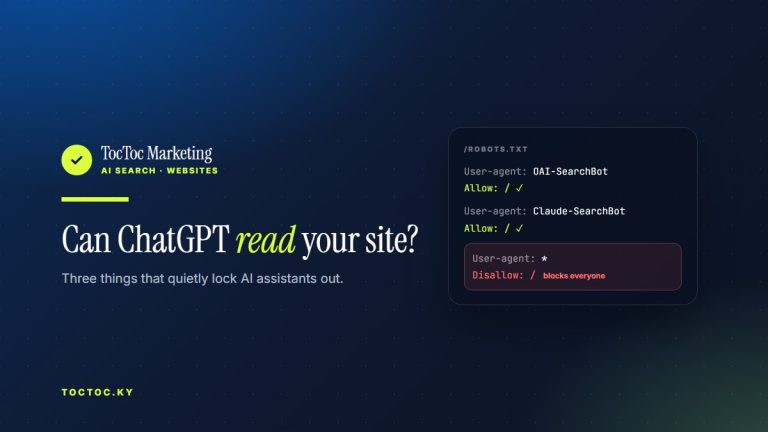
A robots.txt line written years ago, a security setting nobody remembers, a menu built in JavaScript. Three ways a site becomes invisible…
6 Oct 2026Run a free instant audit — classic SEO, AI visibility (GEO/AEO) and Core Web Vitals speed. Get your scores and exactly what to fix.
Analyze my website free