AEO and GEO: Does a Cayman Business Actually Need to Care?
Three acronyms are being sold hard right now. Here is what each one actually means, which parts are genuinely new, and how to judge anyone charging you for them.
You have probably had the email by now. Subject line something like “Your business is invisible to AI”, followed by three acronyms, a warning that your competitors are already doing it, and an offer to put it right. If you own a restaurant on West Bay Road or run an air conditioning company out of a unit in Industrial Park, you have no reliable way to judge whether any of that is true. That is the whole problem with how AEO and GEO are being sold right now: the pitch is designed for people who cannot check it.
So here is the honest version, from an agency that does this work and still thinks most of the marketing around it is nonsense.
What the three acronyms actually mean
SEO — search engine optimisation — is the old one. A search engine sends a program to read your pages, files what it finds, and later decides which pages to show in a list of blue links when somebody types something. Everything in SEO is about being in that index, being understood correctly, and being judged worth showing. It has been around since the 1990s and it is reasonably well documented, because Google publishes guidance for it.
AEO — answer engine optimisation — is about being in the answer rather than the list. When Google shows a box at the top with the opening hours already in it, or a voice assistant reads one sentence back, or an AI Overview writes a short paragraph above the results, the searcher may never scroll. AEO is the practice of formatting your information so it can be lifted into that box. Nothing about it is new in kind. Featured snippets have been around for years, and people were writing for them long before anyone needed a three-letter name.
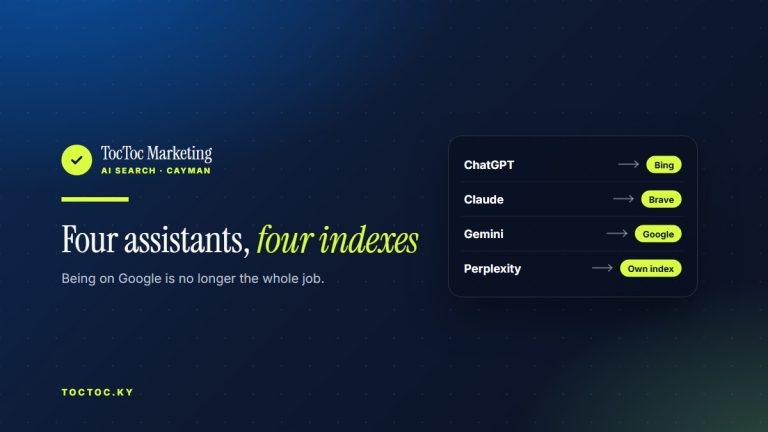
GEO — generative engine optimisation — is the newest and the vaguest. It refers to being included, and ideally named, when ChatGPT, Claude, Gemini, Perplexity or Copilot writes an original paragraph in response to a question. These systems work differently from a search index. They generate text from what they learned in training, and many of them also run a live search mid-answer and read a handful of pages before writing. Which of those two things is doing the work in any given answer is usually impossible to tell from the outside.
Worth saying plainly: the definitions above are ours. There is no standards body for AEO or GEO. Two agencies will define them two different ways, which is convenient if you are being sold both.
Why we do not treat them as three separate products
Because underneath, they run on the same four foundations, and we could not draw an honest line between them if we tried.
- Text a machine can actually read. Not a photo of a menu. Not a PDF. Not text that only appears after a script finishes running.
- Structured data — a small block of code that states, in a format machines already agree on, that this is a restaurant, these are the hours, this is the phone number.
- Business details that match everywhere. Website, Google Business Profile, Facebook, the delivery apps, the old directory listing nobody has touched since 2019.
- Speed and mobile. A page that renders quickly on a phone on Cayman mobile data, not on office fibre.
Do those four things well and you have simultaneously done SEO, most of AEO, and the part of GEO anyone can actually control. Do them badly and no amount of acronym consulting saves you. If somebody offers you SEO and AEO and GEO as three separate services, ask them which of these four they intend to do twice.
What genuinely changes when an assistant answers directly
Three things, and they matter.
The list gets shorter. A results page gives you a column of links and a map pack. An assistant’s answer names two or three places. If your restaurant was sitting somewhere down the first page and getting a trickle of clicks, that position does not exist in this format. You are named or you are not.
The click may never come. Someone asks their phone what time you close, hears the answer, and drives over. You got the customer and no website visit. That is fine — but it means your analytics will understate what is happening, and it means a wrong opening time sitting in a directory is no longer a small error. It is a confident, spoken, wrong answer, and the customer blames you and not the assistant.
What your page says about you starts outranking what it shouts. A model summarising your business will use the plain descriptive sentences, not the hero banner reading “Excellence Redefined”. If your site never states in ordinary words that you are a Sichuan restaurant in George Town open for lunch, there is nothing to summarise. Owners find this the hardest change to accept, because the sentence that works best is usually the one a designer once talked them out of.
What does not change at all
Quite a lot, and this is the part the pitch emails leave out.
For most local searches in Cayman, the Google Business Profile is still doing the heavy lifting — the map, the reviews, the photos, the call button. Reviews still matter, both because people read them and because they are text about you that machines can read. A slow site still loses customers who never wait for it. People still click through to see photos before booking, still want a phone number that dials, still ask a friend at Camana Bay where to eat.
And being easy to find is still worth nothing if the thing people find is not good.
And on an island this size, word of mouth remains the strongest channel most of our clients have. No acronym competes with a food truck court where the food is good on a Friday night.
The unglamorous work is most of the work
Here is what we actually change on a page, and none of it makes a good sales deck.
We take menus out of images and put them in text. There is a two-second test anyone can run: open your own menu page on a phone and try to drag-select the text. If nothing highlights, it is a picture. You can read a picture. A search crawler or a language model reading your page mostly cannot, or reads it badly.
We add structured data. For a restaurant it looks like this, dropped into the page inside a <script type="application/ld+json"> tag:
{
  "@context": "https://schema.org",
  "@type": "Restaurant",
  "name": "Your Restaurant Name",
  "servesCuisine": "Sichuan",
  "telephone": "+1-345-000-0000",
  "url": "https://example.ky/",
  "hasMenu": "https://example.ky/menu/",
  "address": {
    "@type": "PostalAddress",
    "streetAddress": "123 Example Road",
    "addressLocality": "George Town",
    "addressRegion": "Grand Cayman",
    "addressCountry": "KY"
  },
  "openingHoursSpecification": [{
    "@type": "OpeningHoursSpecification",
    "dayOfWeek": ["Tuesday","Wednesday","Thursday","Friday","Saturday"],
    "opens": "11:30",
    "closes": "21:30"
  }]
}
That is it. That is the technology. It is not clever and it is not new — it has been part of ordinary SEO for years — but a surprising number of Cayman sites do not have it, or have it with hours that contradict the hours in the footer. When the two disagree, you have not just failed to help the machine. You have handed it two answers and let it pick.
Then we make the business details agree across every place they appear, and we make the site fast. Across the roughly two dozen client sites we run, built as custom WordPress themes rather than page builders, the speed work is usually the biggest technical lift and the one owners notice first, because a page that opens immediately is something you can feel on your own phone long before it shows up anywhere else.
The part that is genuinely new: being quotable
This is the one real difference, and it is worth understanding properly.
A search engine ranks pages. A generative system writes a sentence and, when it cites, picks a source to name. Those are different games. The second one rewards text that stands alone — a direct answer in plain words, near the top, that still makes sense lifted out of its paragraph. It rewards being the original source of a specific thing: a test, a definition, a local fact nobody else has written down.
A concrete illustration. On 26 August 2026, searching “why can’t AI read my menu” returned a Google AI Overview that described our own two-second test and listed toctoc.ky as a source, alongside Apple. Separately, in a session recorded on 21 August 2026, ChatGPT named two of our clients, Uncle Liu and Coconut Room, when asked where to eat on Seven Mile Beach.
Now the limits, because they are as important as the observation. Each of those is a single session, on a single day, from a single phrasing, from one location. Re-run either tomorrow, or from a different device, or with the words in a different order, and you may get something else entirely — these systems are non-deterministic by design, and their answers vary by phrasing, location and date. Two observations are not data. They are two observations. What they show is that the mechanism is real and reachable, not that it is stable, and not that anyone can be put there on request.
Which is why our wording is that we have influenced AI-generated local recommendations. Not ranked first in them. There is no first.
How to judge anyone selling you AEO or GEO
Four questions. They are all fair, and a competent supplier will not mind them.
“What specifically will you change on the page this month?” The answer should be things you can see afterwards — menu converted to text, schema added, hours corrected in four places, images compressed. If the answer is “we optimise your AI presence”, you are being sold a noun.
“Can you show me the before and after?” Structured data is inspectable. Page speed is measurable. Text either selects or it does not. Ask to see the same page in both states and judge it yourself.
“What do you guarantee?” Nobody can guarantee a position in an AI answer, and nobody can guarantee a position in search either. Anyone who does is either misunderstanding how these systems work or hoping you do.
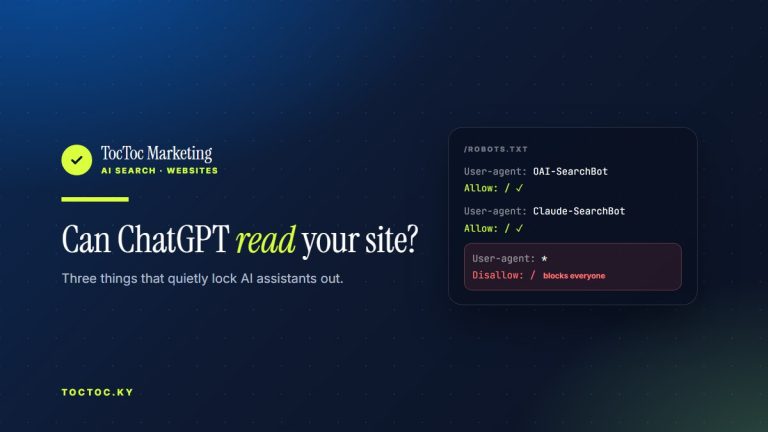
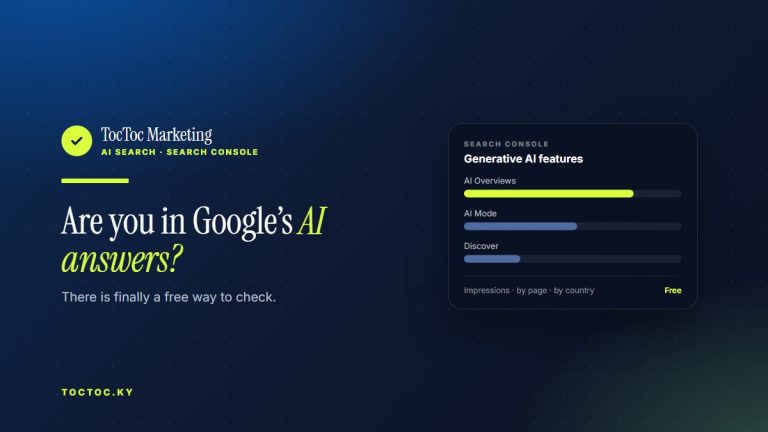
“How will we measure it?” Honest answer: imperfectly. You can check server logs for AI crawlers. You can run the same questions periodically and write down what comes back, dated, so at least you are comparing like with like. As far as we are aware, no assistant publishes anything resembling ranking factors, and Search Console does not break out AI Overview appearances as their own line.
That last one applies to us as well, so we should be straight about it. Our own checker reports an AI visibility score. What it is scoring is the part we can inspect on your page — readable text, structured data, speed, a machine-readable summary of what you do. It measures how ready your site is to be quoted. It cannot measure how often you actually get quoted, because nobody outside those companies can see that. Anyone presenting a score as the second thing is presenting their own invention.
Questions we get asked
Do I need AEO or GEO as a separate service?
Almost certainly not. If your site is fast, readable, marked up and consistent, you have done the work that sits under all three names. Do that once and do it properly.
Does adding llms.txt fix this?
We wrote a whole article about llms.txt and opened it by admitting that no AI company has publicly committed to reading it. That has not changed. It takes very little effort to publish, it does no harm, and it may prove useful later. It is not the kind of thing anyone should be selling you as an ongoing service.
Can you get ChatGPT to recommend my restaurant?
No, and neither can anyone else. We can make your restaurant easy to read, easy to verify and worth naming. Whether a given model names it on a given day, in a given phrasing, from a given location, is outside anyone’s control.
I have no website, just a Google Business Profile. Does this apply?
Mostly it does not, yet — and you probably do not need this article. Get the profile complete and accurate first: hours, categories, photos, replies to reviews. That is a better use of your next month than any acronym.
How long before I see anything?
We do not know, and we would rather say so. The technical changes take effect as soon as your pages are re-crawled. Whether that turns into being named in an answer depends on things none of us can see inside. Anybody giving you a timeline for that is guessing.
If you want a starting point, run your own site through our free SEO and AI visibility checker — it scores the readable-text, structured-data and speed side of this, and drafts an llms.txt while it is at it. Then take the list to whoever is emailing you about acronyms and ask them which items they are actually going to fix.
If you would rather not work through the list yourself, this is what we do: SEO services and AI search visibility for Cayman Islands businesses — the local SEO groundwork first, then the structured data and content work that makes a page quotable. And if the site underneath needs rebuilding before any of that can help, web design and development in Grand Cayman is the other half of the same job.

Written by
Andre Gutierrez
Toc Toc Marketing builds websites in the Cayman Islands that Google and AI assistants can read, understand and recommend.
Meet the team →