Local SEO in Grand Cayman: Why You Are Not in the Map Pack
The map results and the website results are two separate competitions, and most businesses here are losing the one they never entered. What actually moves a Grand Cayman listing.
Someone standing outside Foster’s on a Saturday morning types four words into their phone. Not your business name — they don’t know your business name yet. Just what they need and where they are. Three results come back with a map above them, and one of those three gets the call.
That block of three is the whole game for a local business in Grand Cayman. Below it sits the ordinary list of blue links, and almost nobody scrolls that far on a phone when the answer is sitting right there at the top. If you are not in those three, you are not in the search.
The map results and the website results are two different competitions
This is the part most business owners here have backwards. They pay for a website, the website goes live, and they assume the map listing follows. It doesn’t. Google runs two separate systems and you can win one while losing the other badly.
The map block is fed almost entirely by your Google Business Profile — the thing that holds your hours, your address, your photos, your reviews. The blue links below are fed by your website. A business can have a beautiful site and be invisible on the map because nobody ever finished the profile. The reverse happens too: a shop with no website at all sitting comfortably in the top three because the owner keeps the profile current and customers keep leaving reviews.
Work out which one you are losing before you spend a dollar fixing anything. Search the thing a customer would search, on a phone, standing somewhere on the island. Not your business name. If you appear in the map block, your profile is working. If you appear in the links below but not the map, your website is doing its job and your profile isn’t.
Proximity does most of the work, and you cannot change it
Google weighs three things for local results: relevance, distance, and prominence. Distance is the one nobody wants to hear about, because there is nothing you can do to move your premises closer to the person searching.
What this means in practice on an island this shape: a searcher in East End and a searcher on Seven Mile Beach get materially different results for the same words. If your shop is in George Town, you are fighting uphill for anyone searching from West Bay, and you will lose to a competitor who is simply nearer.
The useful conclusion is not to give up. It is to stop measuring yourself by what you see on your own phone in your own shop. Of course you rank well there — you are standing on top of your own pin. Ask a friend across the island to run the same search and send you a screenshot. That is closer to what a customer actually sees.
Your service area is not the same as your address
Plenty of businesses here have no shopfront. Electricians, cleaners, photographers, mobile mechanics, anyone who drives to the customer. Google has a category for you and most people set it up wrong.
If customers do not come to your premises, you should be a service-area business, and your street address should be hidden. If you leave a residential address showing on a profile where nobody ever visits, you get two problems at once: your home address on the internet, and a listing Google may distrust because it doesn’t match a real commercial location.
Set your service area by district — George Town, West Bay, Bodden Town, North Side, East End — rather than drawing a radius. Districts are how people here actually describe where they are, and they map cleanly onto how the island is laid out.
Reviews are the lever, and they are also the thing nobody asks for
Prominence is the third factor and reviews are the biggest input you actually control. Not just the star average — the count, how recent they are, and whether anyone from the business ever replies.
A listing with a steady trickle of reviews arriving month after month reads differently to Google than one with a burst of fifteen from two years ago and silence since. Recency matters, which means this is never finished.
The reason most businesses have few reviews is not that customers are unhappy. It is that nobody asks. The ask has to happen at the moment the customer is pleased, and it has to be one tap. A printed card with a QR code by the register. A link in the message you send when the job is done. Anything that requires the customer to search for you afterwards will not get done.
Reply to all of them, including the bad ones, and reply like a person rather than a template. A calm, specific reply under a one-star review does more for the next reader than the review costs you.
Your name, address and phone have to match everywhere, and here they usually don’t
Google cross-checks your details against everywhere else you appear — the Chamber of Commerce directory, tourism listings, Facebook, the old site you forgot about. When those disagree, confidence drops.
Cayman has a specific version of this problem. Addresses here are genuinely awkward: PO boxes are normal, many businesses have no street number, and the same location gets written five ways. Then there’s the phone number, which appears variously as 345-555-0100, (345) 555 0100 and +1 345 555 0100.
Pick one format for each and write it down somewhere the whole team can see. Then fix the listings one at a time. It is tedious and it is not clever, but it is the cheapest ranking work available to a business here.
Photos date faster than anyone expects
Profiles with recent photos get engaged with more, and engagement feeds back into prominence. The photos most businesses have were taken the week the profile was created and have sat untouched since.
Take new ones on a phone. The exterior as it looks when someone is walking up to it, which is the shot that helps a customer confirm they’ve found the right door. The inside. The staff. What you actually sell, this month. A handful every few weeks beats a professional shoot once every three years.
Categories are a real decision, not a formality
Your primary category does more than any other single field to determine what you show up for. One primary, chosen precisely, then secondaries for the rest.
The common mistake is choosing something broad because it feels safer. A business that picks a general category to cover everything ends up competing against every business on the island and matching none of them well. The narrow, accurate category usually wins more.
What AI assistants do with all of this
Something has changed in the last stretch and it is worth understanding, because it runs on the same inputs.
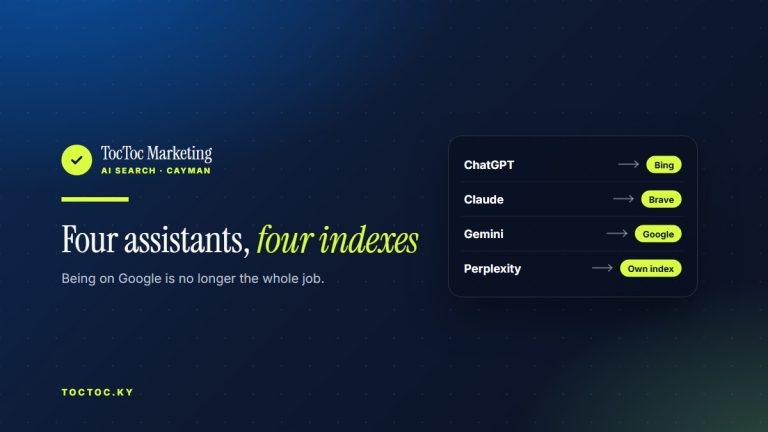
When someone asks ChatGPT or Google’s AI for a recommendation in Grand Cayman, the answer is assembled from the same public signals — your profile, your reviews, your website, what other sites say about you. A business with a thin profile and no clear description of what it does is hard for a language model to recommend, for the same reason it is hard for Google to rank.
The work overlaps almost completely. Sorting out your profile, your reviews and your website copy improves both at once. We’ve written about the llms.txt file and how AI assistants read a site, which covers the website half of it.
One caution worth stating plainly: these answers are not stable. Ask the same question twice and you can get different businesses. Anyone who promises you a permanent position in an AI answer is selling something that does not exist.
Questions we get asked
How long before any of this shows up?
Profile fixes — categories, hours, service area, details that disagree — can move things within weeks, because you are correcting information rather than building authority. Reviews and photos work on a slower curve because the point is the pattern over months. Website changes are the slowest of the three.
We’re a new business with no reviews. Are we stuck?
Not stuck, just early. A complete, accurate, well-categorised profile with real photos will outrank a neglected profile that has been sitting there for years. Get the fundamentals right and start asking every satisfied customer from day one.
Does having a website matter if we rank on the map?
Yes, for two reasons. The map result links to your site, and the person who clicks decides there whether to call you. And the website is what carries you in the ordinary results and in AI answers, where a profile alone gives very little to work with.
Someone offered to get us to the top. Is that real?
No. Nobody controls Google’s local ranking and results differ by where the searcher is standing, so “the top” isn’t even one thing. What can honestly be promised is the work: a complete profile, consistent details, a steady flow of reviews, a site that answers what customers ask.
Can we do this ourselves?
Most of it, yes. The profile is free, the review ask is a habit rather than a skill, and the photos come off a phone. The parts worth handing over are the ones that need to be done consistently over months, which is exactly where it tends to stall.
Where to start this week
Ask someone on the other side of the island to search the thing your customers would search, without your business name, and screenshot what they get. That one screenshot tells you whether you have a profile problem or a website problem, and everything after depends on which.
Then open your Google Business Profile and check three fields: primary category, service area, and hours. Those three are wrong or empty on most listings here, they take ten minutes, and they are the cheapest ranking work you will ever do.
If you want us to look at where you currently stand, we do this for businesses across Grand Cayman — you can see the work we’ve done for local businesses, or read more about our SEO services in the Cayman Islands.

Written by
Andre Gutierrez
Toc Toc Marketing builds websites in the Cayman Islands that Google and AI assistants can read, understand and recommend.
Meet the team →